24/7 Emergency Service101-3993 Henning Drive Burnaby BC V5C 6P7

How to Tell If Your Home Has Poly B

You can usually answer this yourself in about five minutes with a flashlight. Here is exactly what Poly B looks like, where to find it, and how to tell it apart from the pipe people most often confuse it with.
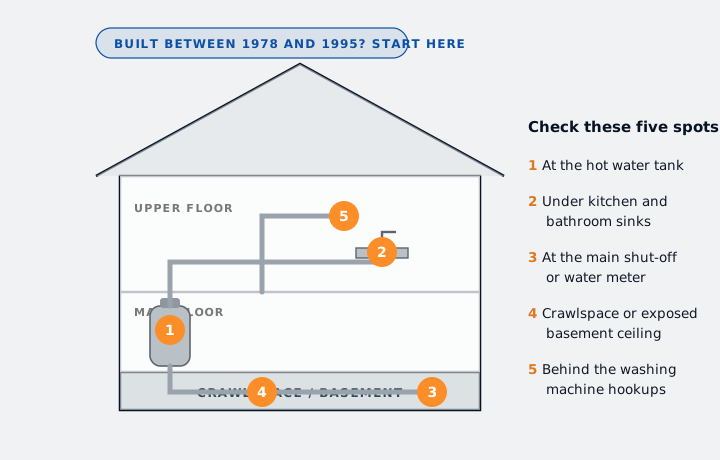
Where to find Poly B pipe in a Metro Vancouver home
Three Tells

Poly B Gives Itself Away Three Ways

Colour, stamping, flexibility. Check all three and you will have your answer.

1

It is grey

Grey or blue-grey is by far the most common. Silver, black and white versions exist. The finish is matte and slightly chalky — never the bright metallic of copper.

2

It says PB2110

This is the one that settles it. PB2110 is printed along the pipe and repeats every few feet, sometimes alongside CSA B137.8 or D-3309. Wipe the dust off and look closely.

3

It bends

Poly B is flexible enough to curve between joists by hand. If the pipe is rigid and will not flex, it is copper or CPVC, not Poly B.

+

Check the fittings

Look at the joints. Original Poly B uses a grey or white plastic insert fitting under a crimped copper or aluminium ring. Those fittings are the weakest part of the whole system.

Where to Look

Five Places It Is Easiest to Spot

You do not need to open a wall. Poly B is almost always exposed somewhere, and if it is grey plastic at one of these points it will be grey plastic behind the drywall too.

  • ✓At the hot water tank — the supply lines entering and leaving the tank are the single best place to look.
  • ✓Under the sinks — open the vanity and the kitchen cabinet and look above the shut-off valves.
  • ✓At the main shut-off — where the water service enters the house, often in a crawlspace or utility room.
  • ✓Crawlspace or basement ceiling — anywhere the joists are exposed you will see the runs directly.
  • ✓Behind the washing machine — the laundry hookups are usually accessible without moving much.
Book a Free Assessment Call Now
Cutaway of a house showing the five places Poly B pipe is easiest to find
Do Not Confuse It With

What Poly B Is Not

PEX

The modern replacement. Often red, blue or white, sometimes grey. Printed with "PEX" and its own standard along the pipe. If it says PEX, you are fine.

CPVC

Rigid cream or tan plastic, joined with glued socket fittings. It will not bend at all. Different material, different failure profile.

Kitec

Orange and blue pipe with brass fittings, mid-nineties to mid-2000s. Also a known problem, also an insurance issue — but not Poly B.

Black poly / ABS

Black ABS is your drain and waste piping, not supply. Black poly outside is usually irrigation or a well line. Neither is Poly B.

Found grey pipe stamped PB2110? Here is what happens next.

Poly B Replacement →What It Means for Insurance
FAQs

Identifying Poly B

A flexible plastic pipe, usually grey or blue-grey, occasionally silver, black or white. It is matte rather than glossy, it bends by hand, and it is normally stamped PB2110 every few feet. Copper is metallic and rigid. If you can flex the pipe with your fingers and it is grey, you are very likely looking at Poly B.
No, and this trips people up. CPVC is a rigid cream or tan plastic and will not bend. Some modern PEX is grey as well — but PEX is printed with its own name and standard along the pipe, where Poly B carries the PB2110 marking. If the printing says PEX, it is not Poly B. When in doubt, take a photo of the printing and send it to us.
The easiest place is at the hot water tank, where the supply lines come in. After that: under kitchen and bathroom sinks, at the main shut-off or water meter, anywhere in a crawlspace or unfinished basement ceiling, and behind the washing machine. If the pipe is grey plastic at any of those points, it is almost certainly grey plastic everywhere else too.
It means it is likely enough to be worth checking. Poly B was installed in Canada from 1978 until roughly 1995, and it was very common in Metro Vancouver through the eighties and early nineties. Plenty of homes from that window were plumbed in copper instead, so age raises the odds without settling the question — go and look.
No. Kitec is a different failed product — an aluminium-cored pipe with brass fittings, usually orange and blue, installed mostly from the mid-nineties into the mid-2000s. Both are problems and both affect insurance, but they fail for different reasons and they look nothing alike. Poly B is grey and all plastic.
Partial repipes are common — somebody replaced the visible basement runs after a leak and left everything inside the walls. That leaves you with a mixed system, and insurers generally treat it as still having Poly B. When we assess a home we check every accessible point rather than assuming the visible section tells the whole story.

Not Sure What You Are Looking At?

Send us a photo or book a free assessment. We will tell you what it is, and we will tell you if it is fine.

Book Now (604) 636-3939
Emergency: (604) 636-3939📅 Book Now