How to Tell If Your Home Has Poly B
You can usually answer this yourself in about five minutes with a flashlight. Here is exactly what Poly B looks like, where to find it, and how to tell it apart from the pipe people most often confuse it with.
You can usually answer this yourself in about five minutes with a flashlight. Here is exactly what Poly B looks like, where to find it, and how to tell it apart from the pipe people most often confuse it with.
Colour, stamping, flexibility. Check all three and you will have your answer.
Grey or blue-grey is by far the most common. Silver, black and white versions exist. The finish is matte and slightly chalky — never the bright metallic of copper.
This is the one that settles it. PB2110 is printed along the pipe and repeats every few feet, sometimes alongside CSA B137.8 or D-3309. Wipe the dust off and look closely.
Poly B is flexible enough to curve between joists by hand. If the pipe is rigid and will not flex, it is copper or CPVC, not Poly B.
Look at the joints. Original Poly B uses a grey or white plastic insert fitting under a crimped copper or aluminium ring. Those fittings are the weakest part of the whole system.
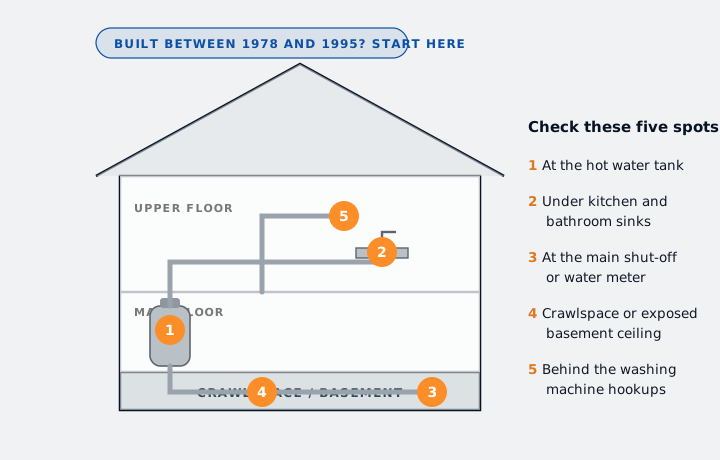
You do not need to open a wall. Poly B is almost always exposed somewhere, and if it is grey plastic at one of these points it will be grey plastic behind the drywall too.
The modern replacement. Often red, blue or white, sometimes grey. Printed with "PEX" and its own standard along the pipe. If it says PEX, you are fine.
Rigid cream or tan plastic, joined with glued socket fittings. It will not bend at all. Different material, different failure profile.
Orange and blue pipe with brass fittings, mid-nineties to mid-2000s. Also a known problem, also an insurance issue — but not Poly B.
Black ABS is your drain and waste piping, not supply. Black poly outside is usually irrigation or a well line. Neither is Poly B.
Found grey pipe stamped PB2110? Here is what happens next.
Send us a photo or book a free assessment. We will tell you what it is, and we will tell you if it is fine.